
4 Microsoft IQs and who on your team owns them
Microsoft IQ is the layer that tells Copilot and AI agents what your company knows. It has four parts: Work IQ, Fabric IQ, Foundry IQ and Web IQ, and the names alone don't tell you much. Below I go through what each one covers, then the six roles that have to do the work before any of it gives good answers. If you are reading that chances are, one of those roles is yours.
Oct 28
/
datatraining
What Microsoft IQ is
Copilot and AI agents can only answer from what they can look up about your organization. Microsoft IQ is the layer they look it up in. Microsoft describes it as a unified intelligence layer for enterprise AI, built from four capabilities.
A few things to clear up first:
A few things to clear up first:
- It's an umbrella name. The four IQs live in different parts of the Microsoft stack (Microsoft 365, Fabric, Microsoft Foundry and Bing), so there is no single "Microsoft IQ" product to buy.
- The model stays the same. IQ decides what it can read before it answers.
- It keeps your permissions. If you can't open a file yourself, Copilot won't quote it to you (meaning different people may get different answers).
- Parts of it were still in preview when I wrote this, so check the status before you plan around a feature.
1. Work IQ: your mail, chats and meetings
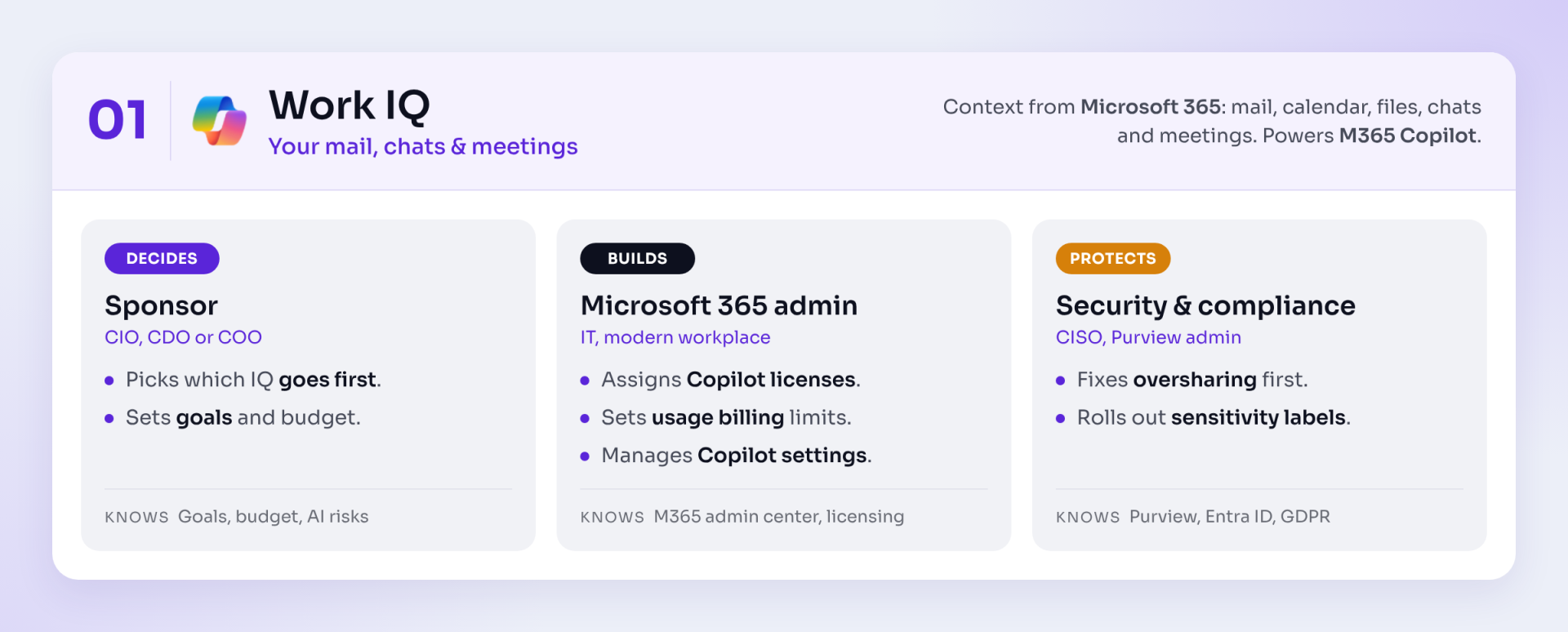
Work IQ is the information that comes from daily work in Microsoft 365: mail, calendar, files, Teams chats and meetings. It also has context on people and how they work together. Business data from Dynamics 365 and Power Platform is included too.
If you've used Copilot in Outlook or Teams, you've already used Work IQ. Microsoft 365 Copilot runs on it, and it's where most companies start, since the Copilot licenses are often already paid for.
Example
Q: What did we decide on Q3?
A: Based on Tuesday's planning meeting and 3 follow-up emails: the Q3 launch moves to September, and marketing owns the webinar.
What to know
What to know
- It only uses what you can see in Microsoft 365.
- Custom agents can reach it through a remote MCP (Model Context Protocol) server, an A2A endpoint or a REST API. That access is billed per use and doesn't need a Copilot license, and admins manage the cost in the Microsoft 365 admin center.
- Risk: Copilot can use any file a person already has access to, including files in sites that are shared more widely than anyone intended. Fix: Check permissions before the rollout starts.
2. Fabric IQ: your business data
If you build Power BI models, this is the most interesting part for you.
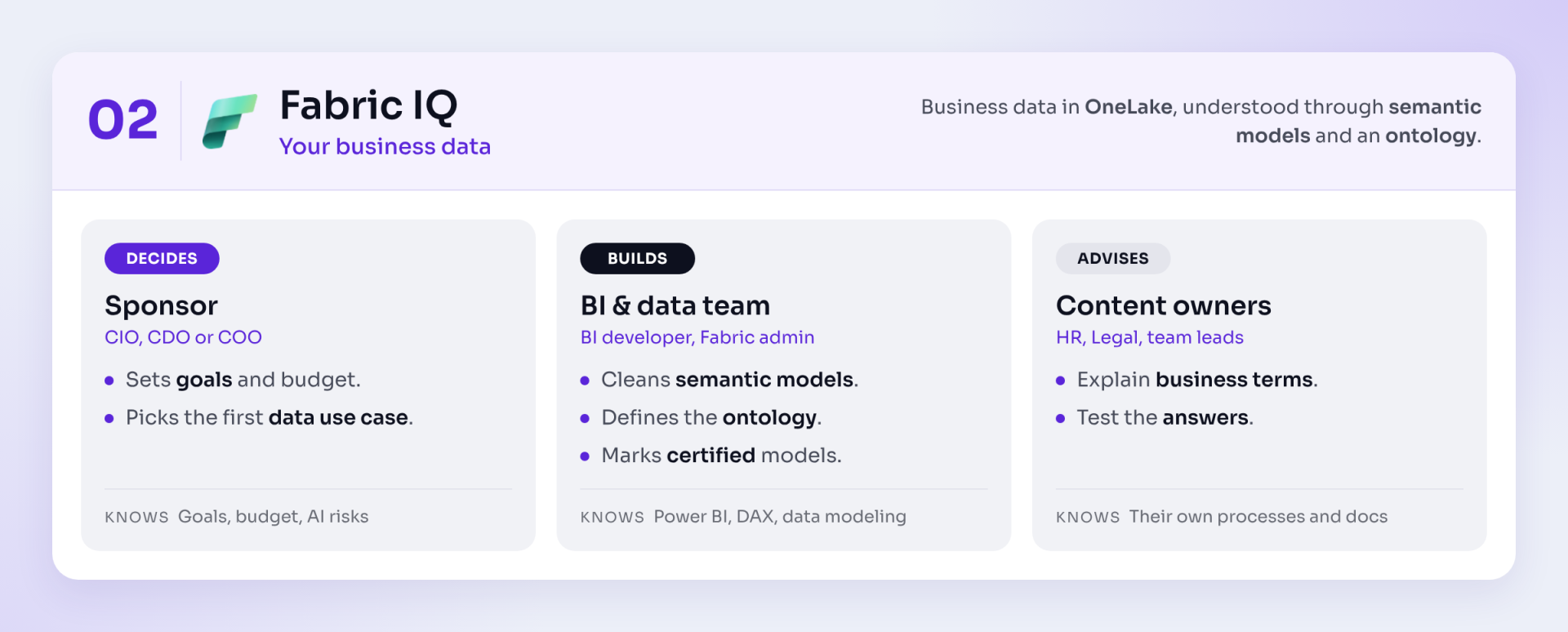
Fabric IQ gives agents an understanding of your business data in OneLake. Beyond tables and columns, it knows what customers, orders, products and stores are and how they connect. On top of the data in OneLake, it adds two layers:
- Semantic models. The same Power BI semantic models you build today. Your measure names, relationships and descriptions become the words an agent works with (if messy, it maybe misunderstood).
- Ontology. A business map of entities, their properties, relationships, rules and metrics. Microsoft's own docs use concepts like Customer and Shipment, defined once and reused everywhere. You can generate an ontology from an existing semantic model, and its DAX measures carry over as metrics. The ontology was still in preview at the time of writing this.
Example
Q: Which stores had more than 5% late shipments last week?
A: 3 stores: Utrecht (8.1%), Rotterdam (6.4%) and Leiden (5.2%). Most delays are on Product category "Outdoor".
What this means for you as a Power BI developer?
What this means for you as a Power BI developer?
An agent reads your model the way a new colleague would: it only has the names and descriptions you gave it.
The habits that help people, will also help AI:
The habits that help people, will also help AI:
- Names. Business-friendly names for tables, columns and measures.
- Descriptions. One on every measure: what it calculates and when to use it.
- Star schema. Fact tables in the middle, dimensions around them. I covered this in 5 core concepts every Power BI developer must know.
- Endorsement. Mark the models people and agents should trust as certified.
3. Foundry IQ: your documents and policies
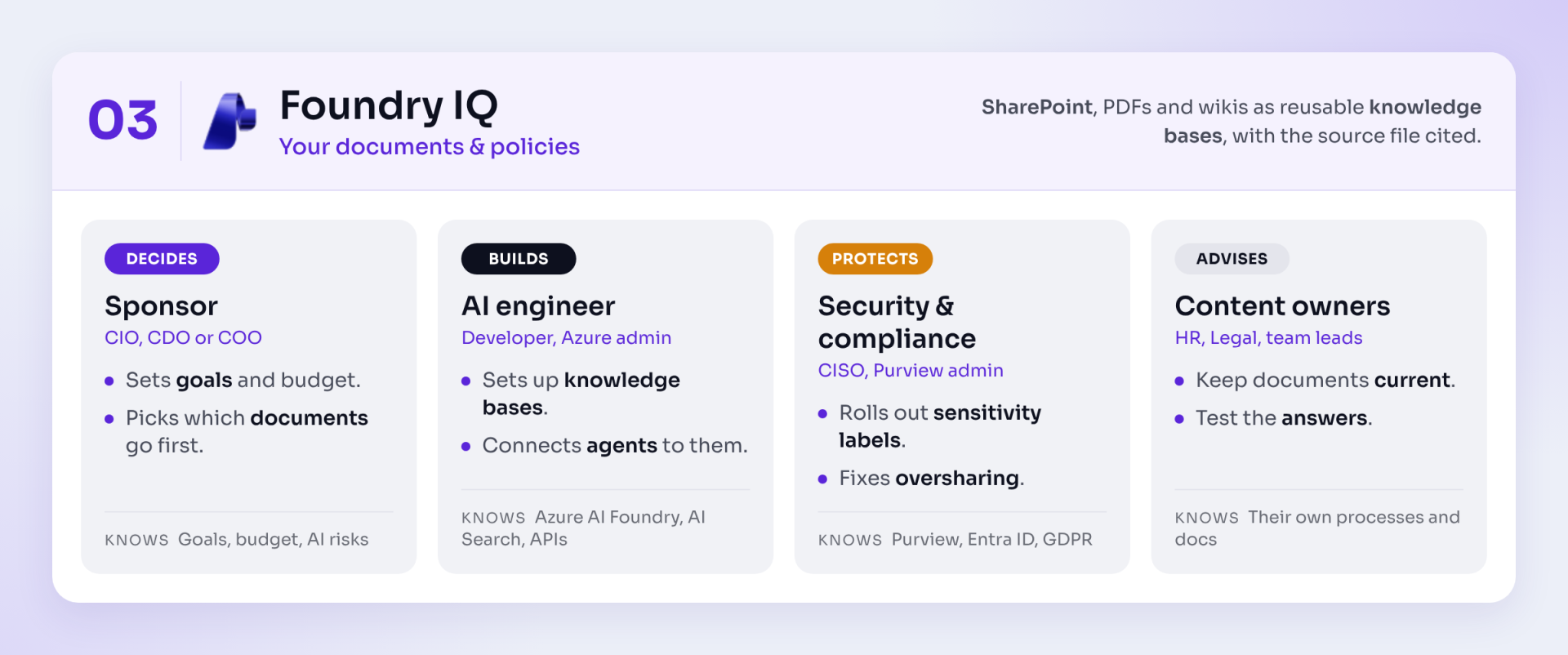
Foundry IQ covers the company's written knowledge: policies, handbooks, contracts, wikis, SharePoint sites and PDFs. You build a knowledge base once and every agent can use it, so HR, Legal and Sales don't each build their own search over the same files. It runs on Azure AI Search, and you manage it in Microsoft Foundry. Some Foundry IQ features are generally available, others are still in preview.
Example
Q: How many remote days do we get?
A: 2 per week. [HR policy, p.4]
Answers come back with citations to the source documents.
What to know
- It respects sensitivity labels from Microsoft Purview, so confidential documents stay confidential.
- An answer is only as good as the document behind it. If an outdated version of a document sits next to the current one, the agent may quote the old one. That's why content owners show up in the roles section below.
4. Web IQ: the public web (limited access so very few companies can even test it)
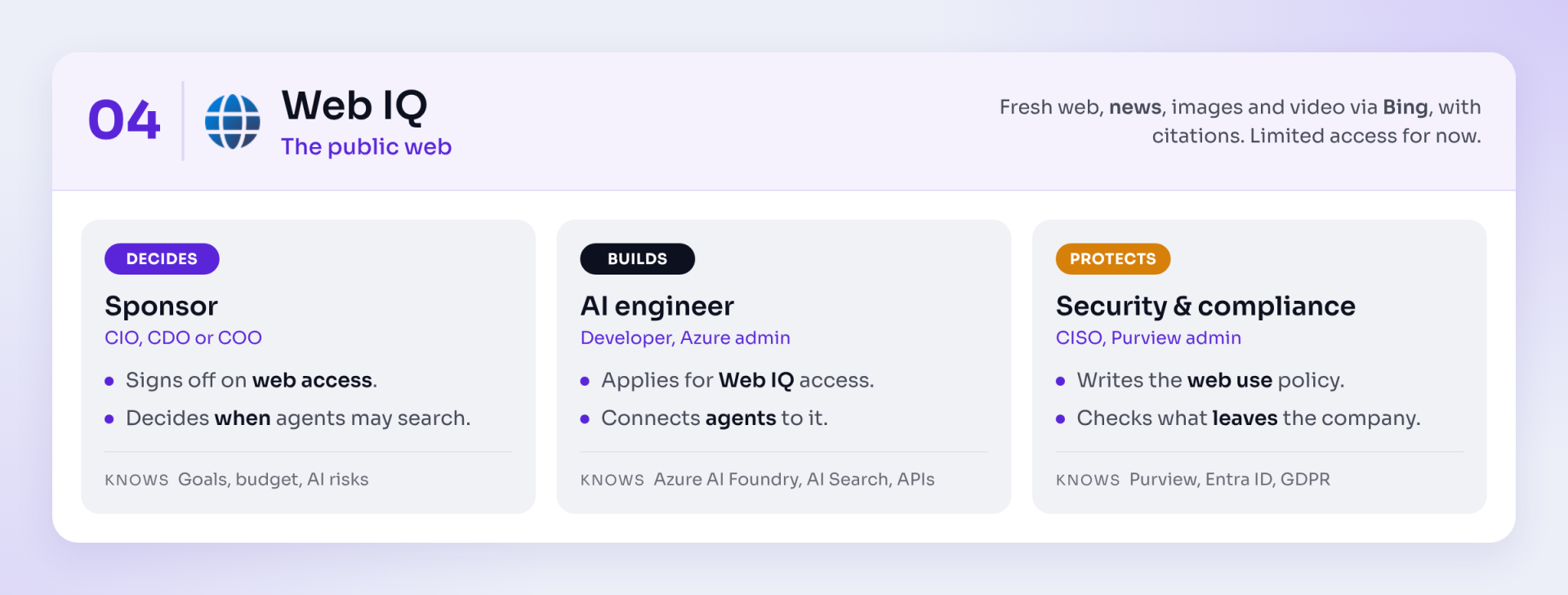
Web IQ is the newest of the four, announced at Microsoft Build 2026. It gives agents current information from the public web, including pages, news, images and video, built on the Bing search index.
Web IQ is the newest of the four, announced at Microsoft Build 2026. It gives agents current information from the public web, including pages, news, images and video, built on the Bing search index.
A model only knows what was in its training data. Web IQ adds facts that are newer than that, with a citation for each: page title, URL and how recent the page is.
Example
Q: Any news on our supplier?
A: Yes. A port strike affected their main hub 2 days ago; deliveries may be delayed. [Source: news article, 2 days ago]
What to know
- Agents call it through an API or an MCP server. There's no search page for people.
- It can't see your internal data. If you want web results next to your own numbers, your agent combines them.
- You deploy it as an Azure service. It needs a paid Azure subscription, and Azure credits don't cover it.
- Meant for enterprise-grade AI agents
- Sending company questions to the web is a policy decision. Someone has to sign off on when agents may search outside.
Using them together
Microsoft describes each IQ as standalone, but you can connect several of them to one agent so it has context from more than one source.
Say a sales manager asks an agent: "Should I worry about the Jansen account this quarter?"
A well set-up agent could:
- Check Fabric IQ for Jansen's order trend and open invoices.
- Check Work IQ for the latest emails and the last account review meeting.
- Check Foundry IQ for the contract terms and renewal date.
- Check Web IQ for recent news about Jansen's industry.
Then it answers in one paragraph, with sources for each part.
The answer is then only as good as the weakest source behind it. A messy semantic model, wide-open SharePoint permissions or an outdated document all show up in what the agent says. So the next question is who does that work.
Who owns what
Microsoft IQ needs people from IT, security, data and the business. The job titles below are examples and differ per company. In a small organization, one person may cover several of these roles.
Microsoft IQ needs people from IT, security, data and the business. The job titles below are examples and differ per company. In a small organization, one person may cover several of these roles.
Most Power BI developers will land in the BI and data space, and you already know most of that work. What changes is who reads your model. Until now it was a report. Now an agent reads it too, and the agent only has your names and descriptions to go on.
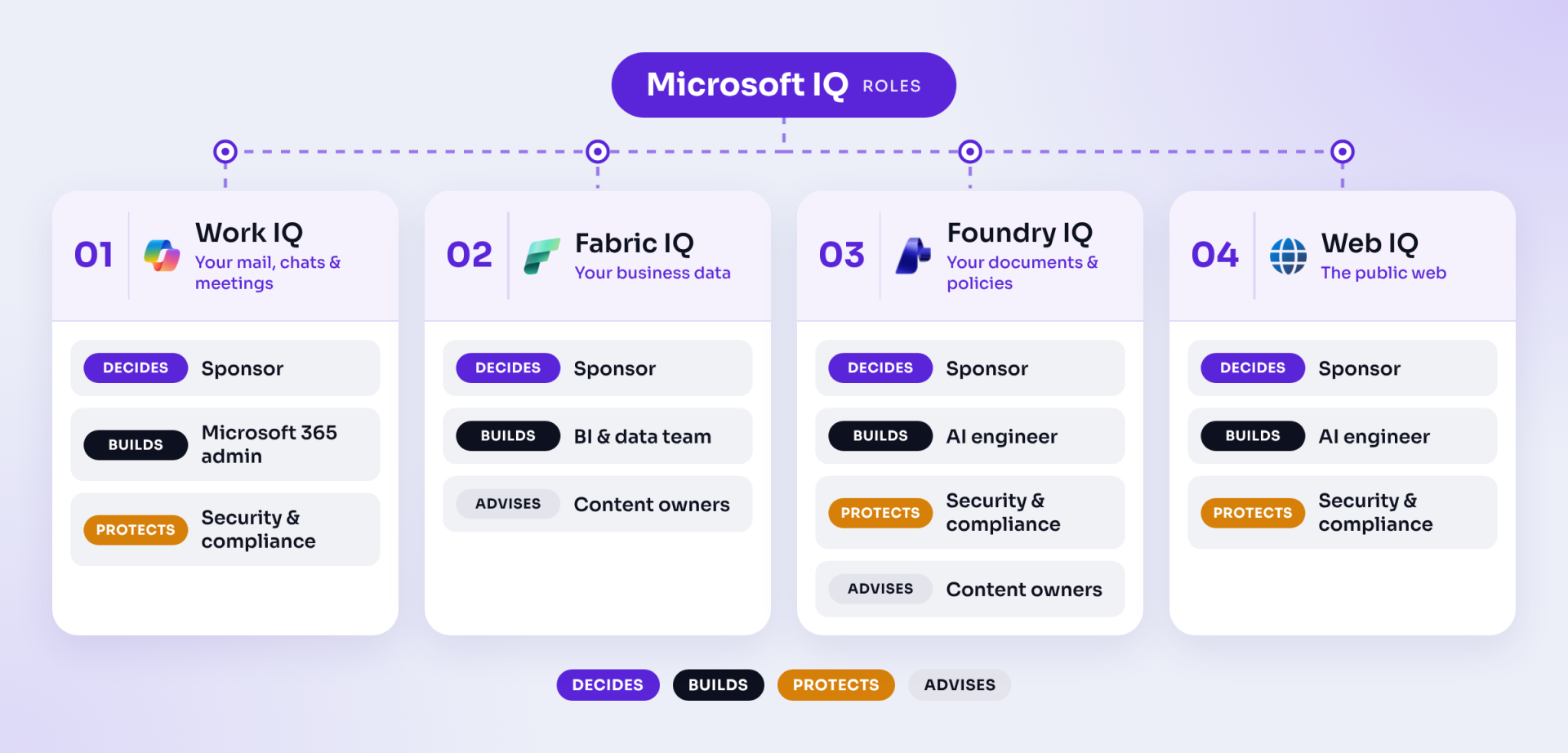
Don't skip the content owners either. They're the only people who can tell you whether an answer about their own policies or processes is right. Should be advisors and extensively test the outputs before announcing it to wider audience.
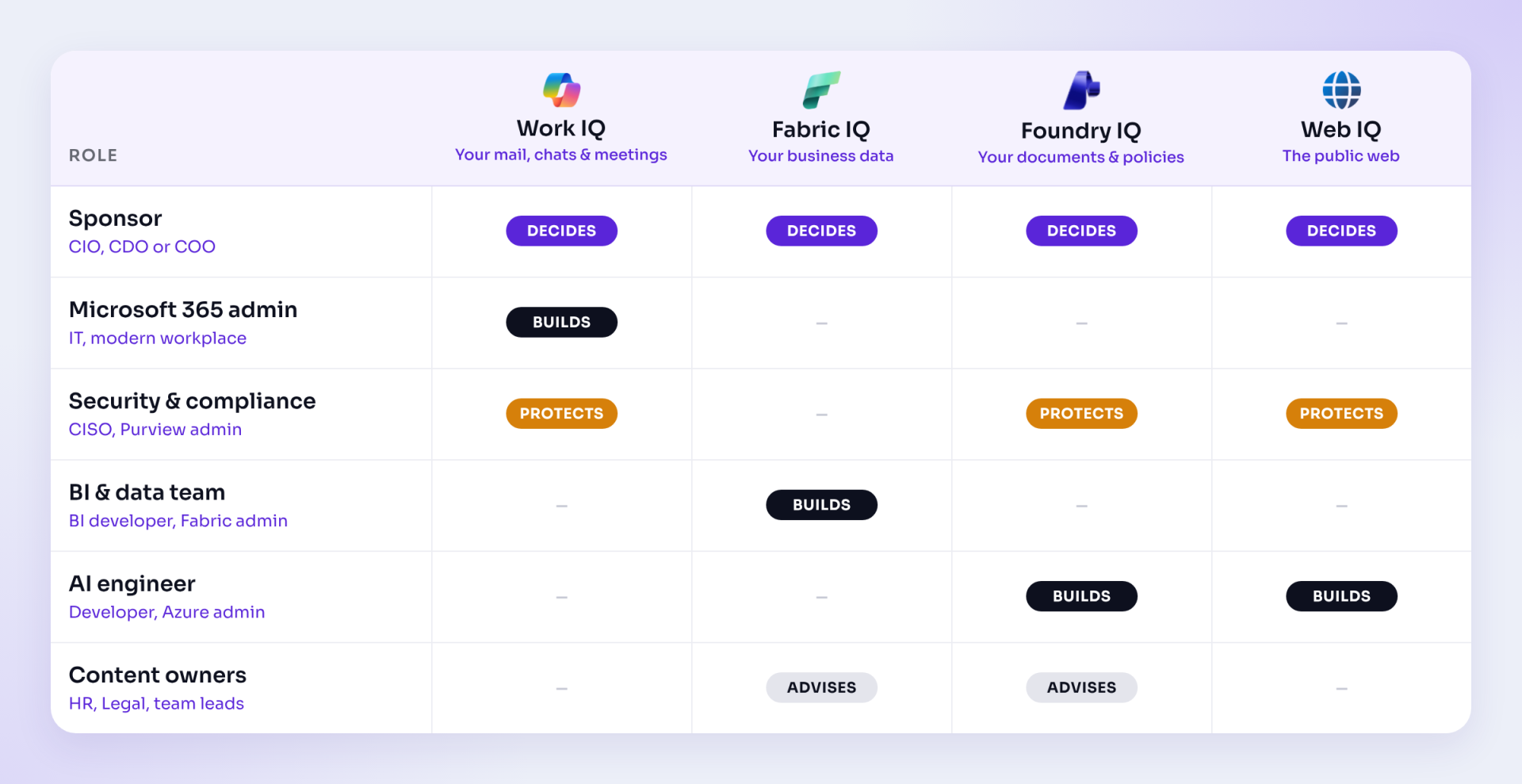
The matrix below shows the full split, and you can reuse it as a starting point:
Where I'd start
You don't need to deploy all four IQs at once. This is the order I'd use for most companies:
- Pick one use case with a clear owner.
- Fix oversharing / Clean up docs in Microsoft 365 before you hand out more Copilot licenses.
- Clean the one semantic model behind that use case (if relevant): names, descriptions, certified.
- Pick one document set, such as the HR handbook, and remove every old version.
- Have the content owners test real questions from their own work and score (!) the answers.
This is the work our AI consulting team does with clients. We check your Power BI and Fabric setup, prepare the semantic model and ontology, set up Copilot and Microsoft IQ, build the agents and train your team to run them on their own. If you're not sure your setup is ready, book an intro call and we'll look at it with you.
Hope this helps a bit :)

COMPANY
Write your awesome label here.
Embedding Power BI in Power Point
Intro Session